
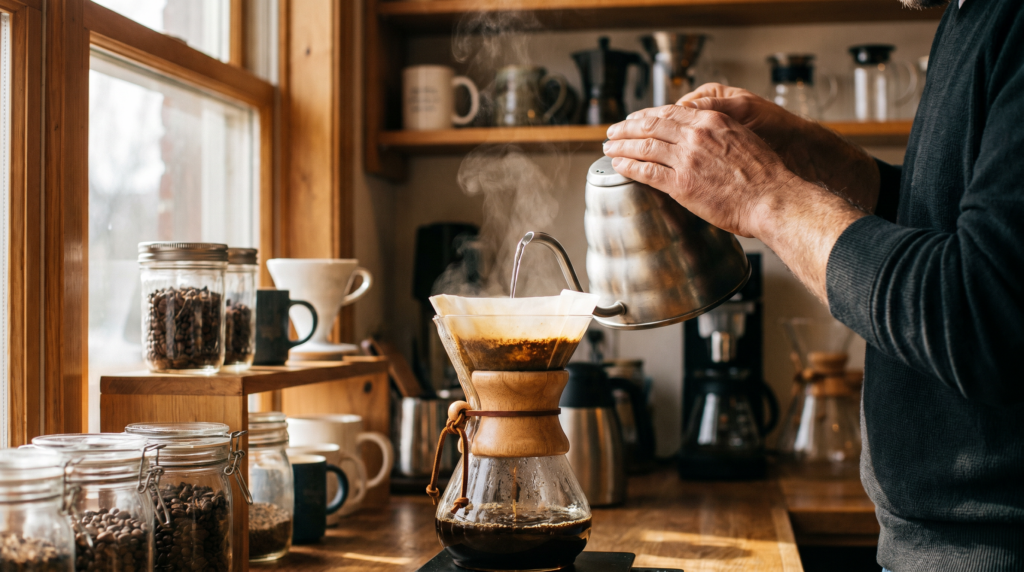
That bag of coffee on the supermarket shelf with “Fresh Roasted” printed across the front? It almost certainly isn’t. By the time a commercially roasted bean travels from the roaster to a warehouse, onto a distribution truck, and finally onto a retail shelf, weeks, often months, have already passed. The “best by” date tells you very little about when those beans were actually roasted.
45% of American adults now drink specialty coffee daily, an 80% increase since 2011, according to the National Coffee Association , yet most of them are brewing with beans that peaked long ago.
Here’s the uncomfortable truth about mass production logistics: large commercial roasters operate on scale, not speed. Roasting in enormous batches, warehousing inventory, and shipping through multi stage distribution networks means freshness is sacrificed before the product ever reaches a consumer. “Best by” dates are typically set 12 months out from roasting, a window that protects shelf life, not flavor.
Reality Check
Source
Time from Roast to Cup
Grocery store bag
2–6+ months
Locally roasted coffee
3–14 days
This distinction is exactly where specialty coffee and commercial coffee diverge. The Specialty Coffee Association identifies a clear Peak Freshness window of 7 to 14 days post roast, when a bean’s acidity, sweetness, and body reach optimal balance. Miss that window, and no brewing technique in the world recovers what’s been lost.
The science behind why that window exists, and how small batch roasters protect it, is where the real story begins.
The Science of Small Batch: Precision Over Production
Now that you understand why supermarket coffee is essentially a stale product dressed in fresh sounding language, the natural question becomes: what actually makes the alternative better? The answer isn’t just sourcing or marketing, it’s rooted in measurable, reproducible science.
Heat Control: The Roaster’s Most Powerful Tool
In a large industrial drum roasting hundreds of pounds simultaneously, heat behaves unpredictably. Beans on the outer edges roast faster than those at the center, creating inconsistency within a single batch. Small batch coffee solves this by keeping loads small enough that heat penetrates evenly and the roaster can intervene at critical moments, slowing development, extending the Maillard reaction, or pulling the batch precisely at first crack.
More responsive temperature adjustments during roast development
Tighter control over roast curve from drying phase to finish
Reduced risk of tipping, scorching, or underdevelopment
The Q Grader: Coffee’s Quality Gatekeeper
Small batch roasters frequently work alongside, or are themselves, Q Graders, licensed professionals trained by the Specialty Coffee Association to evaluate coffee on a rigorous 100 point scale. According to the Specialty Coffee Association (SCA), a coffee must score 80 or higher with zero primary defects to be classified as specialty grade. That floor matters enormously. It means every bean a small batch roaster selects has already passed a cupping evaluation most grocery store blends would fail outright.
Objective sensory scoring eliminates substandard green coffee before roasting begins
Q Grader certification requires passing six rigorous exams
Specialty grading protects flavor integrity from farm to finished roast
Degassing: Why Fresh Coffee Needs Time — But Not Too Much
Immediately after roasting, beans release carbon dioxide through a process called degassing. Brew too soon and CO₂ causes uneven extraction, producing sour, underdeveloped cups. Wait too long and oxidation sets in. Small-batch roasters ship quickly enough that customers receive beans within the ideal degassing window — typically 48 to 72 hours post-roast for espresso, slightly sooner for filter brewing.
CO₂ displacement interferes directly with water to coffee contact during extraction
Industrial supply chains make hitting this window essentially impossible
Proper degassing is a key reason freshly roasted coffee tastes structurally more complex
The roaster who controls batch size controls every variable that determines flavor, and that level of intentionality is something industrial production simply cannot replicate at scale. Which raises a compelling follow up: where do the best small batch roasters actually get their beans in the first place?
Why Independent Local Roasters are Inherently Better
Understanding small-batch precision is one thing. Understanding who is doing the roasting and why that matters is another entirely. Specialty coffee roasters operating independently bring something to the cup that no commercial operation can replicate: a direct, accountable relationship with the coffee itself.
Independent roasters aren’t just buying better beans, they’re building partnerships with the farmers who grow them.
Where commodity buyers purchase coffee by the container load based on price per pound, local roasters often work through direct trade relationships, negotiating directly with smallholder farmers or cooperatives. The result is higher quality green coffee, traceable to a specific farm, region, and harvest season. As Kunjani Naples notes, independent roasters are inherently seen as better because they offer ethically sourced products that support sustainable livelihoods not just the bottom line.
Factor | Independent Roaster | Commercial Giant |
|---|---|---|
Sourcing | Direct trade, farm traceable | Commodity brokers, blended origins |
Roast Timing | Fresh to order, dated batches | Weeks or months before shelf |
Transparency | Farm, harvest date, roast date visible | Minimal disclosure |
Flexibility | Adapts to seasonal crop changes | Locked into annual contracts |
Motivation | Craft and quality | Volume and margin |
This flexibility is a significant advantage. When a crop underperforms in one region, a small roaster can pivot, sourcing from an alternative farm mid season without disrupting quality. Large commercial operations, locked into bulk contracts, simply cannot move that fast.
The roaster’s intent also shapes every decision. Treating coffee as a seasonal fruit rather than a shelf stable grain means accepting that no two harvests are identical, and celebrating that variation rather than blending it away into anonymity.
Of course, even the most thoughtfully sourced, expertly roasted bean can be undone in minutes. Which is why what happens after roasting deserves just as much attention.
The 15-Minute Rule: The Hidden Cost of Pre Ground Coffee
You’ve already seen how small-batch roasting and independent expertise raise the bar. But even the most perfectly roasted bean can be completely ruined before it ever reaches your cup, and it happens faster than most people realize.
The chemistry is unforgiving. When a whole coffee bean is ground, its internal cell structure shatters, exposing an enormous amount of new surface area to open air. That exposure triggers immediate oxidation, a chemical reaction that degrades flavor compounds at a startling rate. According to research published in the Journal of Agricultural and Food Chemistry, ground coffee loses over 60% of its volatile aromatic compounds within just 15 minutes of air exposure.
Fifteen minutes. That’s roughly the time it takes to drive to a store that sells pre-ground coffee.
Those aromatic compounds aren’t just responsible for how coffee smells, they’re the direct source of nuanced flavor. Lose them, and you’re left with flat, bitter, one dimensional brew.
Those compounds, the ones carrying hints of fruit, chocolate, and spice, simply evaporate into the air before the bag is even sealed.
—
Science Corner: Oxidation & Your Coffee Oxidation occurs when oxygen molecules react with the unstable aromatic compounds released by grinding. These volatile molecules are highly reactive and escape rapidly. No vacuum seal fully stops the process once grinding begins.
—
This is precisely why serious local coffee roasters prioritize whole bean sales over pre ground options. It’s not a gatekeeping move, it’s a quality commitment. They know what they’ve carefully sourced and roasted, and they refuse to let chemistry undo it on a shelf.
Which brings up the bigger question: what exactly do you gain when you make the switch? The next section breaks that down in four concrete ways.
4 Irrefutable Reasons to Make the Switch Today
When you stack specialty coffee vs commercial coffee side by side, the differences aren’t subtle — they’re fundamental. Here’s exactly what you gain when you make the switch.
1. Unmatched Flavor Complexity
Benefit: Small batch specialty coffee unlocks a sensory range that commodity coffee simply can’t match. Think bright blueberry notes from an Ethiopian natural process, or deep bittersweet chocolate from a Colombian washed roast, flavors that have nothing to do with added syrups.
Why: Commercial coffee prioritizes consistency at scale, which means blending away anything distinctive. Specialty roasters do the opposite. They highlight origin character, letting altitude, soil, and processing method sing in the cup.
2. Guaranteed Freshness
Benefit: A “Roasted On” date is your quality guarantee. It tells you exactly where you are inside that critical 14 day peak window discussed earlier. A vague “Best By” date, common on grocery shelf bags, tells you almost nothing useful.
Why: Without a roast date, you’re guessing. In practice, commercial bags have often sat in warehouses for months before hitting the shelf. Specialty roasters stake their reputation on transparency, so the date is always front and center.
3. Community & Ethical Impact
Benefit: Buying from a local independent roaster keeps dollars circulating in your community. As Kunjaninaples.com notes, buying local lets you support different communities through a sustainable means of livelihood while receiving a product with a guaranteed unique flavor.
Why: Specialty roasters typically source through direct trade or relationship-based importing, meaning farmers receive fairer compensation than commodity market rates allow. Your morning cup becomes a meaningful economic link.
4. Health & Quality
Benefit: Specialty grade coffee must score 80+ points on a 100 point scale a rigorous standard that rejects beans with physical defects, mold, or insect damage.
Why: Lower defect counts mean fewer undesirable compounds in your cup. Better sourcing practices also reduce the likelihood of mycotoxin contamination, a real concern with poorly stored commodity beans.
Once you understand what separates a truly great bag from an ordinary one, the natural next question is: how do you actually find and vet a quality local roaster?
The Bottom Line: How to Find and Evaluate Your Local Roaster
Making the switch from commodity coffee to small-batch specialty is straightforward, once you know what to look for.
What to Look for on the Bag
Use this checklist before you buy:
Roast date (not a “best by” date — you want freshness, not shelf life)
Single origins or named regions (vague labels like “premium blend” are red flags)
Altitude (higher elevations typically produce denser, more complex beans)
Processing method (washed, natural, or honey, each shapes flavor distinctly)
Seasonal rotation specialty coffee is a seasonal product, so roasters who rotate offerings based on harvest cycles are a trustworthy sign of genuine craft
Questions Worth Asking Your Roaster
Don’t hesitate to ask: When did this arrive? What farm or cooperative sourced it? What grind works best for this process? A knowledgeable roaster welcomes these questions.
Storing Your Beans Right
Keep beans in an airtight, opaque container at room temperature. Avoid the freezer for daily, use coffee, temperature cycling degrades flavor compounds faster than air exposure does.
The bottom line: specialty coffee rewards curiosity. Step beyond the grocery aisle, read the bag carefully, and find a local roaster who treats harvest cycles as seriously as flavor. Your next truly great cup is closer than you think.
Discover more from Coastal Grind
Subscribe to get the latest posts sent to your email.